Wednesday, July 10, 2013

Colour changing chemistry

Colour changing chemistry


Tom and Angus found this experiment on the internet.Rapid Colour changing chemistry is what it is called.We did this experiment because it was on the internet and it looked cool.


Our test was to see which temperature of water works the best! First we got our ingredients, we had 3 cups filled of different ingredients and our experiment worked. 

  Our test was to find out what would make the water change colour using Iodine, hydrogen peroxide, warm water, liquid starch and vitamin C smashed up with book. By Angus and Tom


sabian


Air powered rocket.

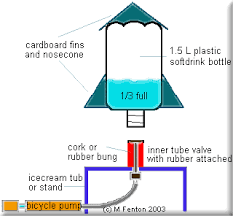
An air powered rocket is a simple contraption made from a bottle, card board fins ,a bike pump, cork and a bike pump valve.


Air fills the bottle-rocket as you pump. As you squash more  and more air into the bottle the pressure increases. Eventually the air pressure will be strong enough to push the cork out.
As the water and air come out the bottom of the bottle, the bottle is pushed in the opposite direction. When the water and air mix goes down, the bottle-rocket goes up! Because the bottle-rocket doesn’t weigh very much it goes a long way up. We put water in the bottle because water is much heavier than air. So the rocket will go further.

Long Lasting Flavour

We all had to work in a group to try and complete our question which was which brand of bubblegum will last the longest?

First we had our hypothesis, we guessed what was going to happen and then wrote it in our log books. (science books) Then we would type it up on the computer on pages and print it out

Next is the equipment, we needed loads of bubblegum brands, a stop-watch and an extra note book and call that a log book or science book.

Then we typed up the method. What we practically wrote was: We each got a piece of the same bubblegum and started chewing. At the exact sam time we started the stop-watch. When one of us had lost the flavour, we wrote the time down in the log book/ science book. Then we would go to the next piece of gum.


After that we done the result. The result is practically a bar graph or pie graph with the results on it and our longest time was 5 gum spearment flavour, but you could write some of it down too.


Now we are almost finished. Now it's the conclusion. There's three parts to a conclusion. One is we said what we would do next time to improve or what we would change. Then we researched up what the answers were before when someone else had done it. Finally we said if we were right with our hypothesis or not and then said the correct answers.


We reckon that the funnest bit about the experiment was actually chewing the tasty gum!!! 

By Joe, Levi and Keegan


We reckon that the funnest bit about the experiment was actually chewing the tasty gum!!! 

The Big Kill


The BIG Kill. Our science project question was 'Does Bleach and Coffee affect plant growth?

To do the experiment we had to start testing. first we go 9 plants, 9 plates and 9 pots. We then measured 50mls of bleach, 50mls of coffee and 50mls of water. We then selected 3 different plants and watered them with water. Then another 3 with coffee and the last 3 with bleach. Before you water them you have to take the plants outside and bring them in at the end of the day. When you water the plants make sure that you water them with the same amount of bleach, coffee and water. The bleach plants died and the coffee and water plants survived. 

We then had to take results like measuring the plant and put that up.We had to type up the hypothesis, the method, the purpose, the conclusion, the equipment and the question. After we had printed out all of the stuff and the pictures, we had to back them onto black paper and stick them onto our science board.

Mrs. Parker had to choose 4 boards out of or class to be marked by some people from Nayland Collage.  Our board was one of the 4 chosen to be marked. Our board didn't get a placing but we got commended work which is pretty much known as 5th place. 

By Rose and Amber


How Air Rockets work

An air rocket requires a pump to pump in compressed air to shoot the rocket into the air.

Air rockets are inventions that when pumped with air will fly into the air like a bird. It works like this:when attached to a pump the rocket will be hollow but a tight fit that when its pumped enough it will fly into the air after a while(if it has it installed)the the air will rush to the top which will be loose and the air inside will push it off revealing a parachute the parachute will ensure your rocket will be fit to fly again!

A air rocket is made with fibre glass,plastic,etc or can be made with plastic bottles an old tire pump and a bike gauge(ask your local garage if they have any old spares for free or, if necessary buy one brand new at a bike shop)also if using a bottle you will need to fill at least quarter of the bottle so the air is trapped in a tight space.

Air rockets are very good to use in OPEN areas where there is no air traffic(don’t wanna shoot an aeroplane down D:)as these are dangerous to use in a crowded air space.

Air Rockets are used as pleasure item's,at concerts and music festival's etc. 

By Xander 


Friday, July 5, 2013

The Hovercraft


Science Project
The Hovercraft

A hover craft is a very simple contraption...

For our project we made a hover craft. 
It is made from-  a balloon, bottle top , other materials and an air pump.

Our test was to see which material works the best! First we made our hover crafts, we made around 5 different crafts to make our experiment work. We used styrofoam, a cd card, cardboard and a plastic plate. 

We tested them on a flat surface and used a ruler,we tested each about seven times each so it would be a fair test.We found out that the Cd worked the best for our hover craft because it had the smoothest surface.

By
Isabella, Emma and Brylee.

Ice ice baby

Room 5 have completed their science fair projects. The 'Ice ice baby' group decided to do an experiment about how colours absorb and reflect heat. We wanted to find out whether lighter or darker colours absorbed the most heat. We found this out by placing an ice cube on different coloured pieces of paper and seeing which ice cube melted the fastest.

Our question was: "What colour conducts heat and makes ice melt the fastest?"
Our hypothesis was that we thought the black would melt the ice faster than the other colours, but it turned out that the the white made the ice melt faster.

Dark colors absorb more heat than light colors, causing a dark surface to become hotter than a light surface made of the same material and exposed to the same heat source. Lighter colours reflect heat, so the light went through the ice, hit the white sheet of paper and reflected back through the ice, which is why white was the fastest.

We had Teachers from Nayland College to Judge our science fair boards and ice ice baby got Highly Commended and Mrs Parker judged our boards and ice ice baby got the best score in the class 17/20!! Yay!!

By Jess and Ashleigh